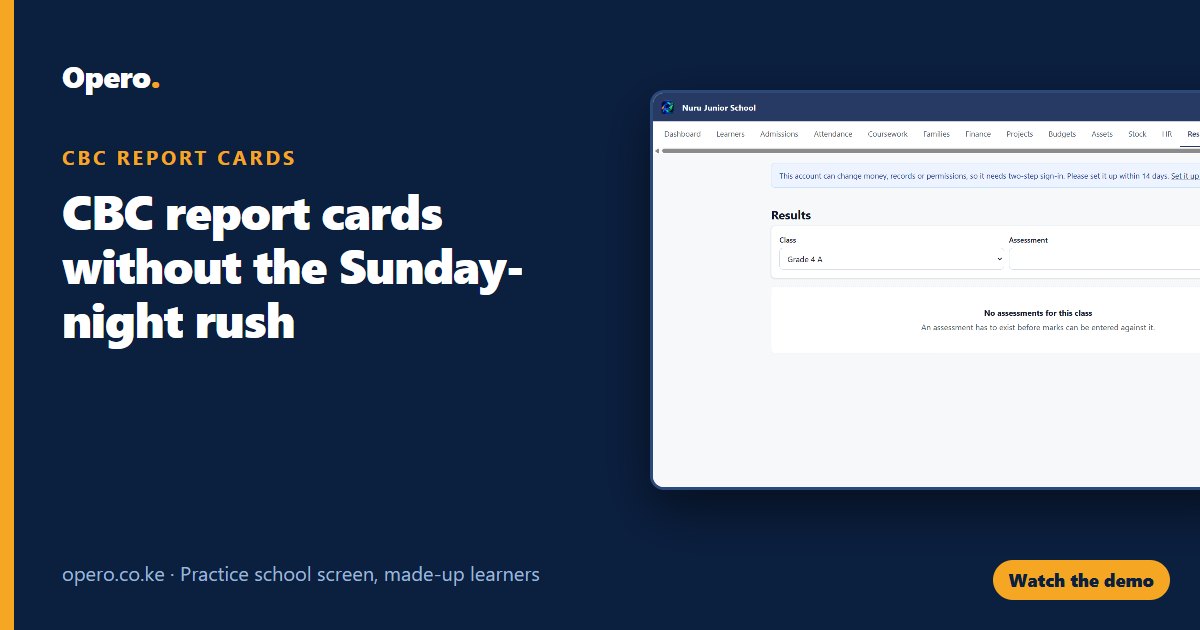
CBC report cards without the Sunday-night rush
Every term ends the same way in many schools. The class teacher has a pile of exercise books, an Excel sheet with half the marks, and a Sunday night to turn them into 40 report cards. The cards go out late, mistakes slip in, and parents ask questions the school cannot answer quickly. This article describes a calmer routine and what Opero can and cannot do to support it.
Why does report-card week become a rush?
Because the work is saved up. Marks are written in books during the term, but typed into a system only at the end. A report card then needs four things at once: every learner's marks, the right subjects for the class, a consistent set of comments, and a teacher who has time to check it.
CBC adds to the load. A card may need competency levels for some learning areas and percentage marks for others, and a school may mix both. Our earlier post on CBC assessment and report cards explains the reporting shapes. This one is about the routine around them.
What does a calmer routine look like?
- Create the assessment when you set the task, not at term end. Name it, set the class, subject and maximum mark.
- Enter or import marks as they happen. A teacher can type marks into a mark sheet, or import them from a spreadsheet. The system is designed to check each mark against the maximum, so a 95 out of 20 is caught immediately. Check this in the demo, as we have not yet run our full test suite on it.
- Review before anyone outside sees anything. Marks stay private until the school publishes them. Publishing is one act, which is what parents then see.
- Generate report cards from the records. The report card document is built from the published results, so it matches what the portal shows.
- Parents read results in the portal, or the school prints the cards. Web push can tell a parent that results are out, once it is switched on for your school. See the parent portal and instant phone alerts.
If you ran this through the term, the Sunday night shrinks to a check, not a typing marathon.
What if our school still uses Excel for marks?
Most do, and that is fine to start. Opero can import marks from a spreadsheet, so a teacher who prefers Excel for a mark sheet can still load it. The move to entering directly in the system can happen class by class. Our walk-through of moving from Excel to Opero covers learners and guardians; marks follow the same pattern of checking first and committing second.
What should a CBC report card show?
Schools differ, and the Ministry's and KNEC's guidance should lead. As a general checklist, a card should show the learner's name and admission number, class, term, each learning area with the assessment outcome, teacher comments, attendance, and the date it was issued. Opero produces the card as a document from the records. We do not claim it matches any official template or that any curriculum body has endorsed it. Confirm the layout your school must use before you print.
Should a school hold report cards when fees are unpaid?
This is a sensitive question, and Opero does not take a side. It gives the school a setting and the school decides. We think the balanced view is useful, so here are the arguments on both sides.
Why some schools hold results: unpaid fees can threaten the school's ability to pay teachers, and some schools use the report card as the moment to talk to a parent about a balance.
Why others never do: a child should not be punished for an adult's debt, parents may be in genuine hardship, and withholding a report can feel like a shaming tactic. A school should also check the Ministry of Education's current guidance and its own board's policy. We are not giving legal advice.
What Opero provides is a school-level setting for the report card document in the parent portal. It is off by default, so a school that never turns it on never holds anything. If a school does switch it on, it chooses:
- A balance threshold. The card is shown when the family owes no more than this amount.
- A grace period. A number of days after the term ends before any hold starts.
- A school-wide release switch. One switch that shows every card again, as an emergency way out.
Whichever the school picks, some protections are built in. The hold controls the report card only. It never hides attendance, notices, the fee statement or the balance, because a family must be able to see what is owed. It never applies to staff. And an authorised person can lift the hold for one learner, with a reason and an expiry date, for example when a payment plan has been agreed. A rule with no human way out would trap children, so every hold has one.
We would encourage a school to decide this deliberately, write it into its fee policy, and tell parents at the start of the year. Leaving the hold off is a perfectly good choice. For the fee side, see payment plans and late fees.
What is not built?
To keep expectations honest, as of 27 October 2026:
- Opero is not a lesson-planning or schemes-of-work tool.
- AI exam generation is not available. It is planned, with no screen to use yet.
- There is no timetable module.
- SMS and WhatsApp results alerts are not live; portal and web push are the channels.
- We have not checked the card layout against every county or private-school format. Ask for a sample with your school's names.
If you are mapping the cost of the pieces, results and report cards are in the base price, KSh 250 per learner per term, with no add-on. See the welcome page for the card; the full comparison is in our 2026 buyer's price guide.
What does a term look like with this routine?
A rough calendar for a thirteen-week term shows how the work spreads out.
- Weeks 1 and 2: set up classes, subjects and the term's assessments, and agree who approves marks.
- Weeks 3 to 10: teachers enter or import marks within a few days of each assessment. The deputy checks a sample every fortnight.
- Week 11: end-of-term assessments are entered, and the office looks for gaps, such as a class with no marks in one learning area.
- Week 12: the school publishes the results and reviews a few report cards before printing.
- Week 13: cards go home, and the portal shows results to families.
The numbers are only an example, and your calendar will differ. The principle is that nothing arrives in the last week that could have been entered in the third. If you want to compare how much this saves, start by counting how many evenings your teachers spend on cards today.
Frequently asked questions
Can Opero produce CBC report cards? Opero supports assessment setup, mark entry and import, publishing, and a report card document built from the published results. Confirm the layout your school needs from a demo with sample data.
Do we need to type all marks into Opero? No. Marks can be imported from a spreadsheet as well as typed on a mark sheet, and the system is designed to check each mark against the assessment's maximum.
Can we withhold report cards from parents who owe fees? Opero has an optional school-level setting, off by default, with a balance threshold, a grace period and a release-all switch. It is the school's decision. It affects only the report card document, and an authorised person can lift it for one learner with a recorded reason.
Is withholding results allowed in Kenya? We do not give legal advice. Check the Ministry of Education's current guidance and your board's policy before using any hold.
How much do results cost? Results and report cards are in the base system at KSh 250 per learner per term, with no add-on.
See it on a practice school. Watch the demo above, then ask for logins to NURU, a practice school with made-up learners. No real child is in it.
Sources: Opero capability review of 27 October 2026 (results, publishing, report card documents and the report-card fee-hold setting); published price card of 27 October 2026. Written by the Opero team. We make no claim of Ministry or KNEC endorsement.