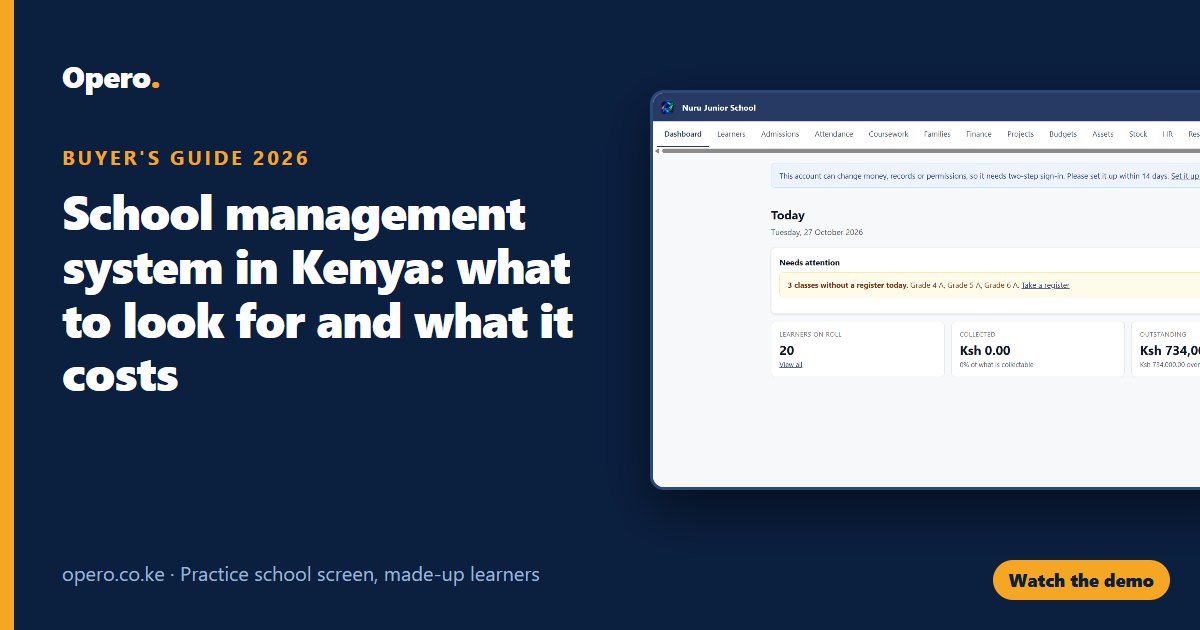
School management system in Kenya: what to look for and what it costs in 2026
Most heads and bursars we speak to are not asking "which software is best". They are asking a plainer question: what will this cost me every term, and what will it stop me doing by hand? This article answers both, using prices that vendors publish, dated, and the price card Opero publishes on its own site. It also says plainly what Opero does not do yet, because a buying guide that hides that is only an advert.
What does a school management system actually do?
A school management system is one set of records that the office, the teachers, the bursar and the parents all read from, instead of five spreadsheets that disagree. For a Kenyan school the useful core is short:
- Learner and guardian records, with admission numbers and classes.
- Attendance, taken by teachers and visible to the office.
- Results and report cards, including CBC assessment.
- Fees: structures, invoices, receipts and statements, with M-Pesa payments matched to the right child.
- A parent portal, so a parent can see a balance, a result or a notice without calling the office.
- Optional extras such as transport records and staff payroll.
If a vendor's demo skips the fees or the report cards, ask why. Those two are where the term-start and term-end rush happens.
What should you check before you sign?
Ask for each item below to be shown, not described. A live demo on a practice school is better than a slide.
- A real M-Pesa payment matching itself to a learner. Ask whether the school's own Paybill is used, or the vendor's.
- A CBC report card for a real class, including how teachers enter marks and who approves them before parents see anything.
- Who owns the data. Can you export every learner record yourself, in a file you can open? Our post on who owns your school's data explains why this matters in year three.
- What happens to a parent who pays late or twice. The answer shows how carefully money was thought through.
- The price in writing, including setup, add-ons and what changes if your roll grows.
- What the vendor says it cannot do. A vendor that lists no gaps is not being straight.
Our older buyer's guide goes deeper on the seven questions. This article is about money.
How much does a school management system cost in Kenya in 2026?
Prices in Kenya are quoted three ways: per learner per term, per year, or a flat monthly fee. To compare them, convert everything to one school. We use a day school of 450 learners, per term. The figures below were read from each vendor's own pages by us on the dates shown. Prices change, so check the vendor before you decide.
| System | How it charges | Cost for 450 learners | Read on |
|---|---|---|---|
| Mwalimu Ease | KSh 110 once per newly admitted learner; year 1 maintenance free; KSh 5,000 a year from year 2 | Year 2 onward about KSh 5,000 a year for the school, plus KSh 110 for each new admission | 27 Oct 2026 |
| Elimikasasa | Free under 100 learners; KSh 2,500 a month for unlimited learners | About KSh 7,500 a term (3 months), SMS extra | 25 Oct 2026 |
| CBC App | Up to KSh 450 per learner a year over 200 learners, plus onboarding | Up to about KSh 67,500 a term if billed evenly | 25 Oct 2026 |
| Mzizi | KSh 250 per learner per term for one pack, KSh 350 combined, plus a configuration fee of KSh 34,800 to 63,800 | KSh 112,500 a term for one pack, KSh 157,500 combined, plus the one-time fee | 25 Oct 2026 |
| Zeraki | We found no published price on its site | Ask for a quote | 27 Oct 2026 |
| Opero | KSh 250 per learner per term base, plus flat add-ons, setup KSh 20,000 or free when switching | From KSh 112,500 a term (base) to about KSh 154,900 (everything) | 27 Oct 2026 |
Three honest readings of that table. First, the cheapest options are cheap because they do less: some have no M-Pesa matching, some are academic only. Second, a free or very low price can still cost you in staff hours if the bursar re-types payments. Third, Zeraki and several others do not publish a price, which makes comparison impossible until you ask. Opero's own prices are in the next section so you can compare line by line.
What does Opero charge?
Opero's price card is on the welcome page and the demo page. The shape is simple:
- Base: KSh 250 per learner per term. This is the same in every tier. It covers learner and guardian records, attendance, results and report cards, and the parent portal.
- Add-ons are flat per term, by school size, not per child. Fees and M-Pesa, Transport safety, and HR and Payroll.
- Setup is KSh 20,000 for a school with no existing system, and KSh 0 for a school switching from one.
- Billing is in week 3 of the term, when fees have started to come in.
For a 450-learner school (the middle size band, 301 to 600 learners) a term costs:
| Tier | Base (450 x KSh 250) | Add-ons | Term total |
|---|---|---|---|
| Base | KSh 112,500 | none | KSh 112,500 |
| Base + Fees | KSh 112,500 | KSh 20,000 | KSh 132,500 |
| Base + Transport | KSh 112,500 | KSh 18,000 | KSh 130,500 |
| Base + Fees + Transport | KSh 112,500 | KSh 38,000 | KSh 150,500 |
| Premium (all add-ons, about 20% off the add-ons) | KSh 112,500 | KSh 42,400 | KSh 154,900 |
A larger school pays more in base fees and in add-on bands, so use the calculator on the welcome page for your own roll.
Is cheaper always better?
No, and neither is dearer. The better question is what your bursar and your office stop doing by hand. Every hour your bursar spends re-typing payments, and every evening teachers spend typing report cards, is already a cost in salaries, even if it never appears on an invoice. Our walk-through of collecting fees by M-Pesa without the spreadsheet shows where those hours go.
That said, if you have under 100 learners and no transport, a free tier may be exactly right, and we would tell you so. Opero is built for schools of a few hundred learners and up, where fees, a bus and a payroll all start to hurt at once.
What does Opero not do yet?
This matters more than what it does, so here it is plainly, as of 27 October 2026:
- SMS and WhatsApp alerts to parents are not switched on. The code exists; the accounts and approvals are not finished. Web push notifications are built and become live once the latest release is deployed and set up. See parent portal and instant phone alerts.
- KRA eTIMS invoicing is not built. Our post on eTIMS for schools explains what schools must do meanwhile.
- There is no timetable module and no separate learner portal.
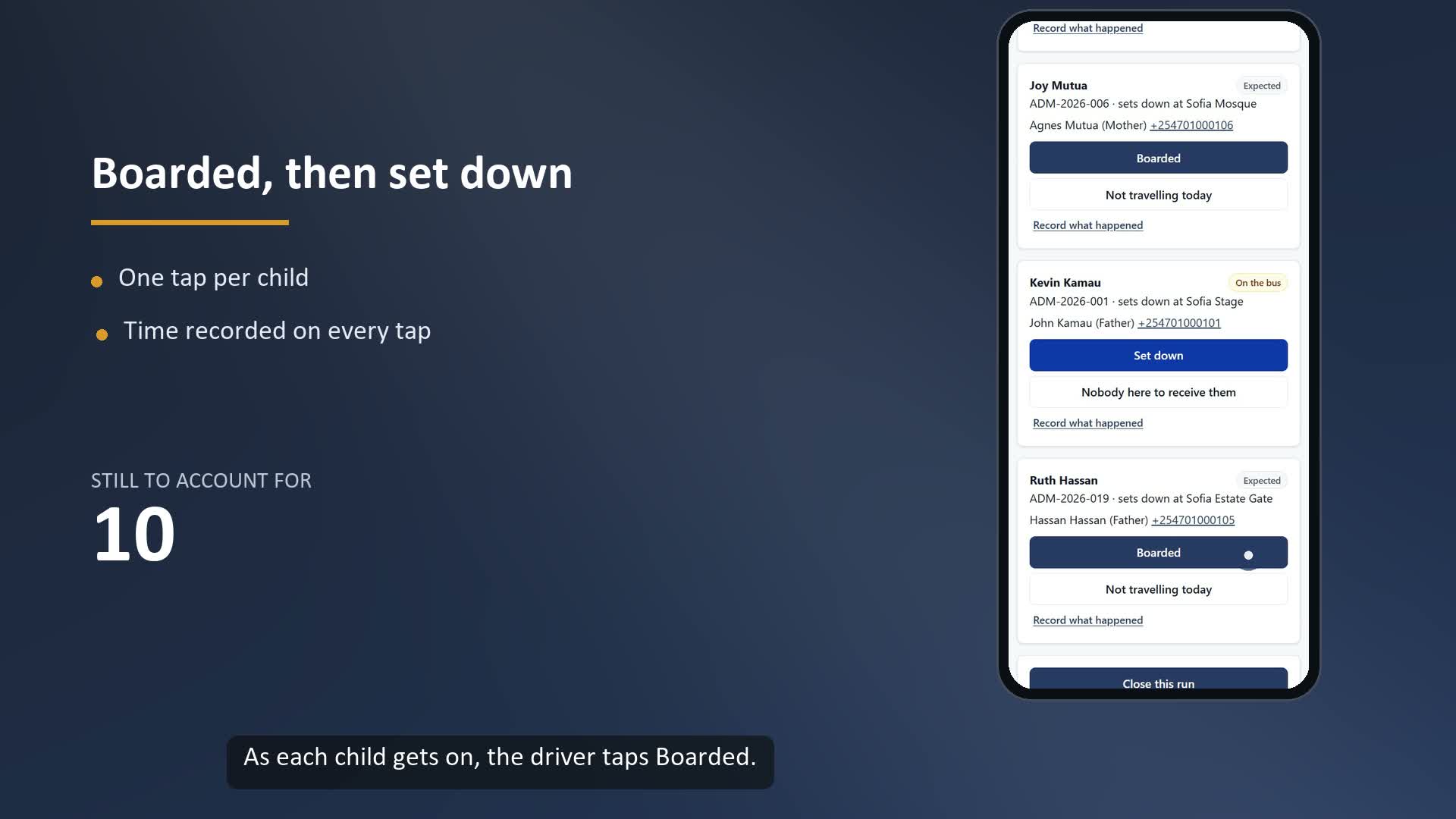
- There is no GPS tracking hardware. Transport records boarding, drop-off and parent confirmation. It is not a tracking device.
- Opero is young. We will not invent a customer list. Ask for the demo school and try it.
Which system fits which school?
- Under 100 learners, tight budget: a free tier, such as Elimikasasa's or EBingwa's core, may be enough. Check what SMS and payments cost on top.
- A small private primary that mainly needs CBC report cards: MwalimuEase or CBC App are cheap and focused. Check M-Pesa support.
- A day school of 300 to 1,500 learners with fees, a bus and staff payroll: this is where one system for everything pays off, and where Mzizi and Opero both compete.
- A big secondary: Zeraki is reported to be used mostly by secondary schools. We found no published price, so ask for a quote.
If you have a transport fleet, read how a bus run can account for every child. If you are coming from Excel, see moving your school to Opero.
Frequently asked questions
How much does a school management system cost in Kenya? In 2026, published prices range from free to about KSh 350 per learner per term. Cheaper tools are usually narrower. Opero costs KSh 250 per learner per term for the base system, plus flat add-ons for fees, transport and payroll.
Is there a free school management system in Kenya? Some vendors offer a free tier, for example for schools under 100 learners, or a free core with paid SMS and payments. Read what is excluded before choosing.
Do I need M-Pesa built in? For most schools, yes. Without it someone re-types payments from SMS messages or bank statements. Ask to see a payment match to a learner during the demo.
Can I switch from my current system? Usually yes. Ask what happens to your records and what it costs. Opero waives the setup fee for a school switching from another system, and agrees the scope of moving old records in writing.
What should I ask a vendor first? Ask to see a real M-Pesa payment matched to a learner, a CBC report card, a data export you can open yourself, and the full price in writing.
See it on a practice school. Watch the demo above, then ask for logins to NURU, a practice school with made-up learners. No real child is in it.
Sources: vendor pages read on the dates in the table (Mwalimu Ease pricing page 27 Oct 2026; Elimikasasa, CBC App and Mzizi as recorded in Opero's market scan of 25 Oct 2026; Zeraki home page 27 Oct 2026). Opero prices from the published price card of 27 Oct 2026. Written by the Opero team. Prices change, so check each vendor before you decide.